Problem
For fast moving consumer goods in Vietnam, the biggest demand event of the year is Tet, and it does not sit still on the calendar. Because it follows the lunar calendar, the Lunar New Year lands on different dates each year. Most forecasting tools assume the same yearly pattern every time, so they place the Tet spike in the wrong weeks. Planners are left either short of stock or holding too much at the worst possible moment, and they end up correcting the numbers by hand in spreadsheets, with no record of who changed what or why.
Solution
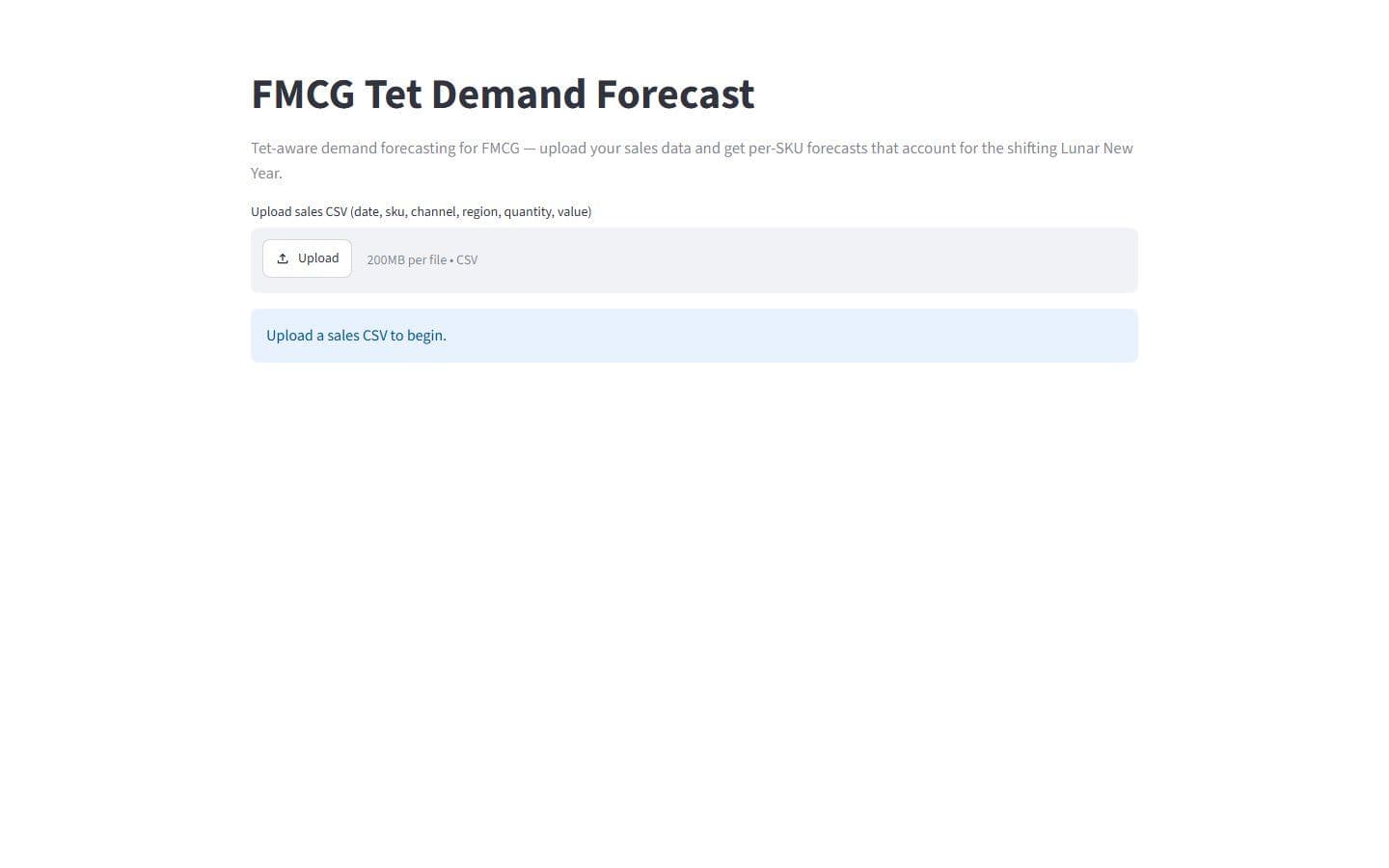
TetCast is a forecasting tool built around Tet. A planner uploads a sales file and chooses a few settings: how to group the data, how far ahead to forecast, and how much weight to give the Tet period. The file is a CSV with the columns date, sku, channel, region, quantity, and value.
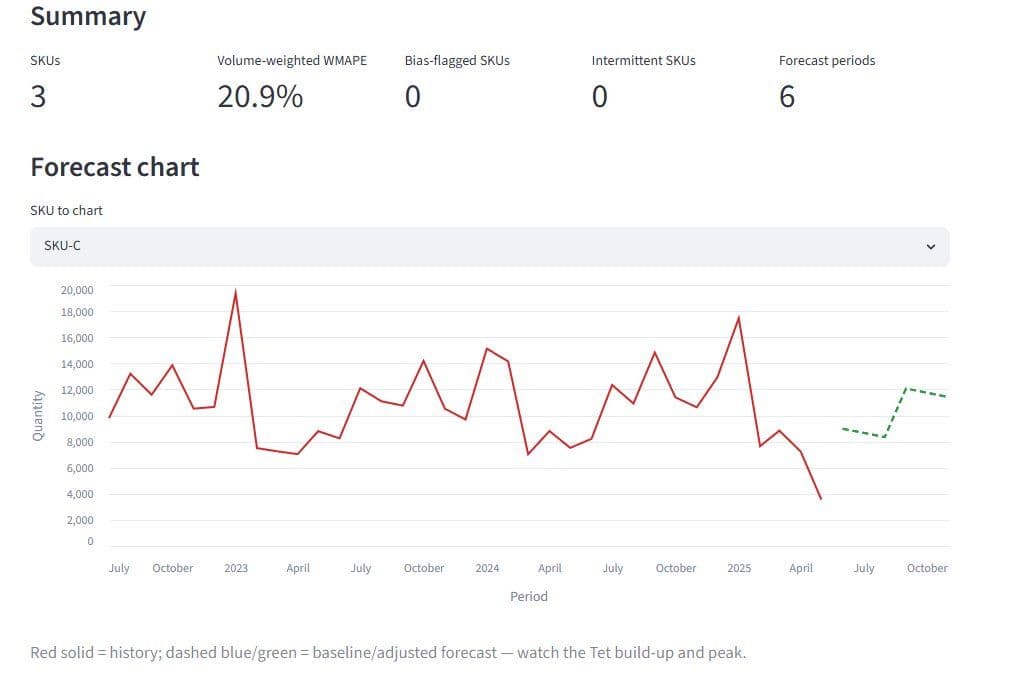
TetCast then returns a per-SKU forecast with a short summary at the top and a chart that puts the sales history next to a baseline forecast and a Tet-adjusted forecast, so the planner can see the difference at a glance.
How it works
For each SKU, TetCast fits more than one forecasting model, currently Holt-Winters and SARIMAX, with Prophet available as an option, and keeps the one that scores best. It scores each candidate with a Tet-weighted WMAPE, an accuracy measure that pays extra attention to the weeks around the Lunar New Year, so the model chosen is the one that gets Tet right rather than the one that looks best on quiet months.
It also flags the SKUs a planner should look at twice: those whose forecasts lean consistently high or low, and those that sell too irregularly to forecast cleanly. When a number needs adjusting, for example to add a promotion uplift, the planner makes the change through a business override layer that records the author and the reason, so every adjustment carries an audit trail. Results export to CSV, Excel, and a Power BI dataset with a defined schema, so the forecast can flow into the reports a team already uses.
Outcome or status
TetCast is a working tool, currently being prepared for public deployment. It runs today as a Python application built with Streamlit. The figures shown in the screenshots come from a synthetic demo dataset and are not client results. What TetCast provides is a forecasting workflow shaped around the one event that most affects Vietnamese FMCG demand, with automatic model selection, quality flags, an auditable override step, and exports that fit the tools a team already has.